
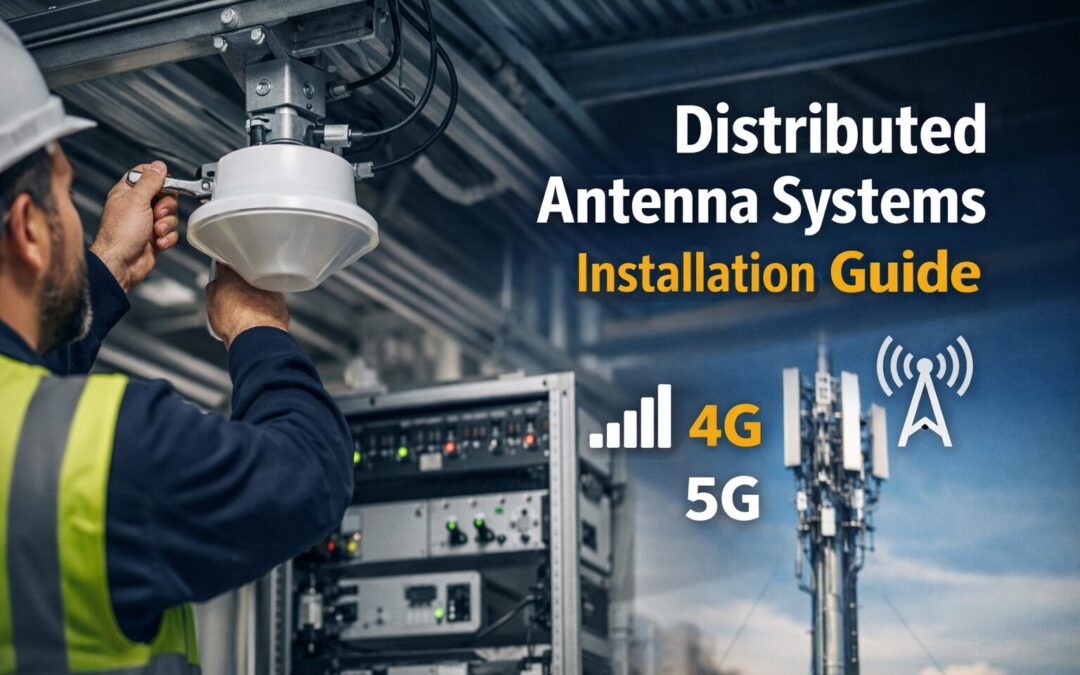
Distributed Antenna Systems installation is critical for delivering reliable indoor mobile coverage in modern commercial and infrastructure environments. As buildings become larger, denser, and more complex, external mobile signals are often unable to penetrate structural materials such as concrete, steel, and low-emissivity glass. A properly designed and installed DAS ensures consistent 4G and 5G coverage throughout the entire asset, supporting operational continuity, safety, and compliance.
This guide explains how DAS installations work, when they are required, how projects should be delivered, and what asset owners and project managers need to understand before engaging a contractor.
What Is a Distributed Antenna System
A Distributed Antenna System is a network of antennas connected to a central signal source that distributes mobile coverage evenly throughout a building or structure. Instead of relying on one external signal source, DAS brings coverage indoors and spreads it across all required areas, including basements, plant rooms, lift shafts, tunnels, and enclosed spaces.
DAS solutions are commonly deployed in hospitals, transport infrastructure, commercial towers, shopping centres, stadiums, industrial facilities, and underground environments where uninterrupted mobile coverage is essential.
AM2PM Group delivers DAS as part of fully integrated in-building coverage solutions, managing design, civil works, installation, testing, and commissioning under a single scope of responsibility.
When a DAS Installation Is Required
A Distributed Antenna Systems installation is typically required when indoor mobile signal levels fail to meet operational or regulatory requirements. This may present as dropped calls, poor data speeds, unreliable connectivity, or complete signal loss in certain areas of a building.
Many new developments are now required to demonstrate compliant indoor mobile coverage before occupancy approval. Retrofitting DAS into existing assets is also common, particularly in older buildings that were not designed for modern data demand or 5G frequencies.
High-risk environments such as tunnels, rail assets, and critical infrastructure require specialist contractors with experience in RF engineering, safety compliance, and complex construction sequencing.
The DAS Installation Process Explained
A successful DAS installation begins with a detailed RF survey and site assessment. This identifies coverage gaps, interference sources, structural constraints, and carrier requirements. Based on this data, the system is engineered to suit the building layout, expected user density, and future capacity needs.
Once the design is finalised, enabling works are completed. This often includes containment installation, penetrations, pit and pipe, and structural mounting. At AM2PM Group, these civil and structural works are self-performed to maintain quality control and WHS compliance.
Cabling, antennas, head-end equipment, and power systems are then installed with precision to ensure signal balance and minimal loss across the network. Integration with carrier networks and emergency services systems follows, prior to full commissioning.
The final stage involves system testing and validation. Coverage levels, signal strength, and performance are verified against design criteria, and full documentation is provided as part of handover.
Common Challenges in DAS Installations
Many DAS projects fail due to fragmented delivery models. When multiple subcontractors handle design, civil works, cabling, and commissioning, accountability is diluted and defects are more likely to occur.
Other common issues include poor antenna placement, inadequate future capacity planning, non-compliant installation methods, and insufficient testing before handover.
AM2PM Group mitigates these risks by delivering DAS projects as a single integrated scope. All critical works are performed in-house, which is particularly important in live operational environments where safety, access control, and sequencing are critical.
DAS and 5G Readiness
Modern DAS systems must be designed to support 5G frequencies and increasing data demand. Legacy systems that were not engineered with future capacity in mind often require costly upgrades or replacement within a few years.
A correctly engineered DAS installation accounts for carrier evolution, spectrum changes, and increased device density. This future-ready approach ensures long-term value for asset owners and operators.
AM2PM Group’s experience delivering nationwide 5G infrastructure builds ensures that DAS systems are engineered with scalability and longevity in mind.
Compliance and Regulatory Considerations
In Australia, DAS installations must align with carrier specifications, building codes, and emergency services coverage requirements. Non-compliant systems can delay occupancy approvals, expose asset owners to operational risk, and result in costly remediation.
Regulatory guidance on telecommunications infrastructure and RF exposure standards is provided by the Australian Communications and Media Authority.
Why Contractor Capability Matters
DAS installation is not a standard electrical fit-out. It requires specialist knowledge of RF engineering, telecommunications standards, and high-risk construction environments.
AM2PM Group operates nationally and does not subcontract critical scopes. This ensures consistent delivery, clear accountability, and reduced project risk, particularly on complex builds involving tunnels, rooftops, rail corridors, and live commercial assets.
Frequently Asked Questions About DAS Installation
How long does a Distributed Antenna Systems installation take?
Project duration depends on asset size, complexity, and access constraints. Smaller commercial sites may take several weeks, while large infrastructure projects can extend over several months.
Can DAS be installed in an occupied building?
Yes. Experienced contractors can stage works to minimise disruption. This is common in hospitals, offices, and transport environments.
Does DAS support multiple carriers?
Most modern DAS systems are designed to support multiple carriers, subject to commercial agreements and technical approvals.
Is DAS required for emergency services?
In many jurisdictions, compliant indoor coverage for emergency services is mandatory, particularly in high-rise and public infrastructure assets.
What is the difference between DAS and small cells?
DAS distributes signal from a central source across multiple antennas, while small cells act as individual base stations. DAS is typically preferred for large or complex environments.
How long does a DAS system last?
A well-designed DAS system can operate effectively for 10 to 15 years when engineered for future capacity and maintained correctly.
Can an existing DAS system be upgraded?
Many systems can be upgraded or expanded, although older installations may require partial replacement to support modern frequencies.
Who is responsible for ongoing maintenance?
Responsibility depends on ownership arrangements, but many asset owners engage specialist contractors for inspections, testing, and upgrades.
How much does a DAS installation cost?
Costs vary depending on building size, coverage requirements, and complexity. Accurate pricing requires a site assessment and RF survey.
Talk to a DAS Installation Specialist
If you are planning a new development, upgrading an existing asset, or experiencing unreliable indoor mobile coverage, engaging an experienced telecommunications contractor is critical.
AM2PM Group delivers fully integrated DAS and in-building coverage solutions nationwide, supported by in-house crews and proven delivery across commercial, industrial, and infrastructure environments.