
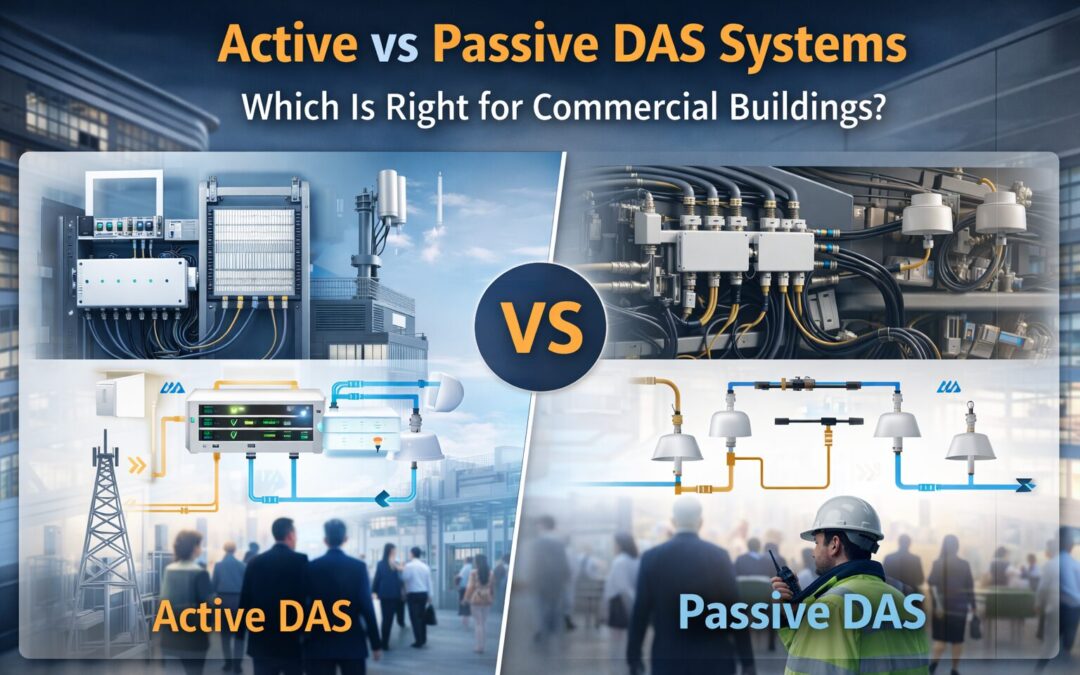
Active vs passive DAS systems are one of the most common decision points when planning in-building mobile coverage for commercial buildings. While both approaches are designed to solve indoor signal issues, they differ significantly in performance, scalability, cost structure, and long-term suitability.
For asset owners, developers, and facilities managers, choosing the wrong Distributed Antenna System can lead to coverage gaps, carrier rejection, compliance issues, and expensive redesigns. Understanding how active and passive DAS systems work, and where each is appropriate, is essential before committing to design or construction.
This guide explains the differences clearly, using real-world delivery considerations rather than theory alone.
Why DAS matters in commercial buildings
Modern commercial buildings create challenging RF environments. Dense construction materials, large floorplates, underground spaces, and increasing user demand all degrade external mobile signals. As a result, relying on macro networks alone is no longer viable in most commercial settings.
A properly designed DAS ensures consistent 4G and 5G coverage throughout the building, supporting business operations, safety systems, and regulatory compliance. In many sectors, including healthcare, transport, and public infrastructure, reliable indoor coverage is now considered a baseline requirement rather than an optional upgrade.
The choice between active and passive DAS systems directly impacts how well that requirement is met.
What is a passive DAS system?
A passive DAS system distributes mobile signal using passive RF components such as coaxial cabling, splitters, couplers, and antennas. The signal source is typically a carrier base station or repeater, and the system relies on careful signal balancing to overcome losses across the network.
Passive DAS systems are most commonly deployed in smaller commercial buildings where distances are short, layouts are simple, and user density is relatively low. In these environments, signal attenuation can be managed without the need for active amplification at each antenna point.
From an installation perspective, passive systems are generally simpler and involve fewer active components. This can make them attractive for low-complexity projects with limited future expansion requirements.
However, as buildings become larger or more complex, passive DAS systems face practical limitations. Signal loss increases with distance, making it difficult to maintain consistent coverage across multiple floors, basements, or extended corridors.
What is an active DAS system?
An active DAS system distributes signal using fibre optic cabling and remote units that actively manage and amplify RF output at each coverage zone. The signal is converted from RF to digital or optical form at a central head-end, transported over fibre, and then converted back to RF at the remote unit.
This architecture allows active DAS systems to deliver consistent performance across large areas with minimal signal degradation. It also enables precise control over coverage levels, making active systems well suited to environments with varying layouts, high occupancy, or complex structural elements.
Active DAS systems are commonly used in hospitals, airports, tunnels, transport hubs, high-rise commercial towers, stadiums, and large mixed-use developments. They are also preferred where multiple carriers, frequency bands, and future upgrades must be supported.
AM2PM Group delivers complex in-building coverage projects nationwide, including active DAS installations in high-risk and high-compliance environments.
Performance and coverage differences
The most significant difference between active and passive DAS systems is performance consistency.
Passive DAS systems rely on signal strength from the source and careful RF design to compensate for losses across cables and splitters. As the network grows, maintaining even coverage becomes increasingly difficult, particularly in deep indoor or underground areas.
Active DAS systems actively manage signal output at each remote unit, allowing coverage to remain consistent regardless of distance from the head-end. This makes them far more reliable in large commercial buildings where coverage quality must not vary between floors, zones, or tenants.
For environments that must support high user density or mission-critical communications, active DAS systems provide a clear performance advantage.
Scalability and future readiness
Scalability is a critical consideration for commercial buildings with long asset lifecycles.
Passive DAS systems can be difficult to expand. Adding new coverage areas, frequency bands, or carriers often requires rebalancing the entire network or replacing major components.
Active DAS systems are designed to scale. Additional remote units, carriers, or services can be integrated with minimal disruption, making them far more future-ready. This flexibility is particularly valuable for buildings expected to undergo tenant changes, occupancy growth, or technology upgrades over time.
For asset owners focused on long-term value, scalability is often a deciding factor.
Installation complexity and delivery risk
Passive DAS installations are generally quicker and less complex, which can suit straightforward projects with limited access constraints.
Active DAS installations involve fibre infrastructure, head-end equipment, carrier integration, and commissioning processes that require specialist expertise. Delivery quality depends heavily on contractor capability and coordination with carriers and consultants.
AM2PM Group self-performs all core scopes across telecommunications infrastructure, including fibre works, civil excavation, electrical integration, and commissioning. This end-to-end control reduces delivery risk on complex DAS projects and ensures compliance from design through to handover.
Cost considerations beyond upfront pricing
While passive DAS systems typically have lower upfront costs, they can become expensive to modify or upgrade as building requirements evolve.
Active DAS systems require a higher initial investment but often deliver lower total cost of ownership due to better performance, longer service life, and easier upgrades. When evaluated over a 10 to 20 year period, active systems frequently provide stronger long-term value for large commercial assets.
Cost decisions should be based on lifecycle outcomes rather than installation price alone.
Compliance and carrier acceptance
Carrier acceptance and regulatory compliance play a major role in DAS system selection.
Active DAS systems are often preferred by mobile carriers in large commercial buildings due to their performance stability, monitoring capabilities, and support for multi-band and multi-carrier deployments.
In Australia, in-building coverage systems must align with carrier technical standards and national regulatory requirements. Guidance from the Australian Communications and Media Authority informs spectrum use, interference management, and compliance expectations for DAS deployments.
Early engagement with carriers and experienced DAS contractors reduces the risk of rejection or costly redesigns later in the project.
Which DAS system is right for your commercial building?
Passive DAS systems can be suitable for smaller commercial buildings with predictable coverage requirements and limited future expansion.
Active DAS systems are typically the right choice for large, complex, or high-density environments where performance, scalability, and compliance are critical.
The correct solution depends on building size, layout, occupancy, carrier requirements, and long-term operational goals. There is no one-size-fits-all answer, but there is a clear distinction between systems designed for simplicity and those designed for scale.
Frequently asked questions about active vs passive DAS systems
What is the main difference between active and passive DAS systems?
Passive systems distribute signal using coaxial cable and passive components, while active systems use fibre and remote units that actively manage signal output.
Is an active DAS system always better than a passive system?
Not always. Active systems are better suited to large or complex environments, while passive systems can be effective in smaller buildings with lower coverage demands.
Can passive DAS systems support 5G?
Some passive systems can support 5G, but performance and scalability may be limited compared to active DAS architectures.
Which DAS system is more future-proof?
Active DAS systems are more future-ready due to their modular design and ability to support new carriers and frequency bands.
Are active DAS systems more expensive?
They generally have higher upfront costs but often deliver lower long-term costs through easier upgrades and improved performance.
Do mobile carriers prefer active or passive DAS systems?
For large commercial buildings, carriers typically prefer active DAS systems due to their reliability and monitoring capabilities.
How long does a DAS installation take?
Timeframes vary depending on system type, building size, and access conditions. Active DAS projects usually require longer planning and commissioning phases.
Can AM2PM Group deliver both system types?
Yes. AM2PM Group designs and installs both active and passive DAS systems and recommends the most appropriate solution based on building requirements.
Is DAS required for compliance in commercial buildings?
In many sectors, reliable indoor coverage is increasingly linked to safety, operational, and regulatory compliance obligations.
Speak with a DAS specialist before committing to design
Choosing between an active and passive DAS system is a technical, commercial, and operational decision. Getting it wrong can result in poor coverage, delayed approvals, and costly rework.
AM2PM Group works with asset owners, builders, and consultants to assess requirements, engage carriers, and deliver compliant, high-performance DAS solutions across Australia.
If you are planning a new commercial build or upgrading an existing facility, speak with our team early to ensure the right DAS architecture is selected from the outset.