
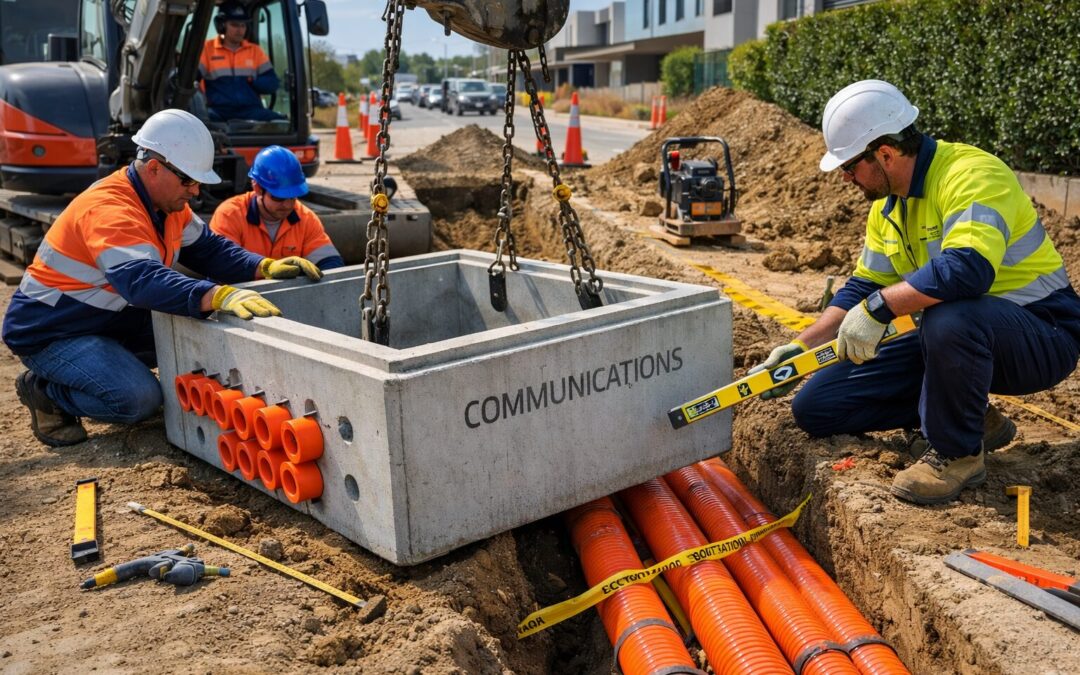
Pit and pipe installation is a critical component of telecommunications infrastructure delivery across Australia. For NBN and carrier networks, these civil works form the permanent pathway for fibre assets that must remain protected, accessible, and compliant for decades. When pit and pipe installation standards are not met, the result is failed inspections, delayed network activation, and costly remediation.
Unlike general civil construction, pit and pipe works for telecommunications are governed by strict technical specifications, safety requirements, and quality assurance processes. These standards exist to protect fibre networks, support long term maintenance, and ensure safe access for future upgrades. This article outlines the key pit and pipe installation standards for NBN and carrier networks, what delivery teams must get right on site, and why experienced telecommunications civil contractors are essential to successful outcomes.
Why Pit and Pipe Standards Matter in Telecommunications Projects
Telecommunications pit and pipe infrastructure is not a temporary construction activity. Once installed, it becomes part of a live network asset expected to perform reliably over its full design life. Incorrect pit placement, inadequate trench depth, poor compaction, or non compliant materials can lead to conduit deformation, water ingress, cable damage, and unsafe access conditions.
For NBN and carrier projects, civil defects do not exist in isolation. Poor pit and pipe installation directly affects fibre hauling, splicing, commissioning, and service activation. Even minor non-conformances can trigger failed handovers and rework that impacts downstream trades and contractual milestones.
This is why network owners impose strict standards that go well beyond general civil best practice. Pit and pipe works must be delivered precisely to design, documented accurately, and verified before fibre installation begins.
NBN Pit and Pipe Installation Requirements
NBN pit and pipe installations are governed by defined national standards that specify approved materials, pit spacing, trench profiles, conduit depths, and reinstatement requirements. These standards are designed to ensure consistency across the network and to protect fibre assets in a wide range of environments.
Pit locations are determined by network design and must provide safe access for cable hauling and maintenance. Installers are required to maintain minimum offsets from property boundaries, road assets, and existing services. Trench depth and width requirements ensure conduits are adequately protected from surface loads and future excavation works.
Bedding material selection, backfill methodology, and compaction are critical elements of NBN compliance. Inadequate compaction can lead to surface settlement, pit movement, or conduit damage, all of which can result in failed inspections.
NBN also mandates minimum separation distances between telecommunications conduits and other utilities such as power, gas, and water. These clearances are essential for safety and long term asset protection. Non compliant separations are one of the most common reasons for rejected works.
In addition to physical installation standards, NBN projects require compliance with traffic management, environmental controls, and work site safety obligations, particularly in live roads, footpaths, and urban corridors.
Further guidance on NBN construction requirements is published by NBN Co.
Carrier Network Pit and Pipe Standards
Carrier pit and pipe installations often involve higher capacity infrastructure and additional technical complexity. Major carriers typically apply project specific specifications that sit on top of Australian Standards and local authority requirements.
These works may include larger conduit diameters, multi duct banks, concrete encasement, or integration with existing carrier pits and routes. Tolerances are often tighter, particularly where pit and pipe assets support mobile backhaul, data centres, or enterprise fibre networks.
Carrier networks place strong emphasis on asset longevity and future scalability. Accurate pit alignment, verified conduit continuity, and detailed as built records are essential to allow future expansion without disruptive rework. Poor documentation or undocumented design changes frequently result in delays at handover.
Australian Standards and Local Authority Compliance
All telecommunications pit and pipe works must comply with relevant Australian Standards and statutory requirements in addition to NBN or carrier specifications. AS 3725 governs underground utility structures, including pit performance, installation, and loading requirements.
Excavation and trenching activities must align with WHS legislation, Safe Work requirements, and approved safe work method statements. In congested service corridors, careful planning is required to manage existing utilities and prevent asset damage.
Local councils and road authorities impose specific conditions for reinstatement of footpaths, pavements, and verge areas. Failure to meet reinstatement standards can delay approvals and final sign off, even where pit and pipe installation itself is technically compliant.
Contractors delivering telecommunications civil works must understand how to manage these overlapping requirements without slowing project delivery.
Quality Assurance and Testing Before Fibre Installation
Pit and pipe works are not considered complete until quality assurance checks confirm compliance. Visual inspections verify pit seating, lid installation, conduit alignment, and workmanship. Conduit continuity must be confirmed to ensure fibre can be hauled without obstruction.
Mandrel testing or rodding is commonly required prior to fibre installation. Any obstruction discovered after backfilling often results in costly excavation and remediation.
Accurate as built documentation is also mandatory. Pit locations, depths, conduit routes, and deviations from design must be recorded to support asset management and future maintenance activities.
Why Self Performed Civil Delivery Reduces Risk
A significant number of pit and pipe defects occur at handover points between subcontracted civil crews and telecommunications installation teams. Misalignment, undocumented changes, and poor reinstatement often become apparent only when fibre crews arrive on site.
Self performed delivery models reduce these risks by maintaining control over excavation, pit placement, conduit installation, and reinstatement. When civil works are delivered by teams experienced in telecommunications infrastructure, quality and compliance are embedded throughout the process rather than inspected at the end.
AM2PM Group delivers pit and pipe works as part of an integrated telecommunications civil capability, combining excavation, compliance management, and documentation under one delivery structure. This approach reduces rework, improves coordination with fibre and wireless teams, and lowers overall project risk.
More information on AM2PM’s civil delivery capability is available on the Civils and Strengthening page.
For projects delivered under NBN scopes, further detail can be found on the NBN services page.
Pit and Pipe Installation in Complex and Live Environments
Urban corridors, live roads, rail interfaces, and high traffic commercial sites introduce additional complexity for pit and pipe installation. Services congestion, restricted work windows, and strict stakeholder controls demand experienced planning and execution.
In these environments, pit and pipe works must be sequenced carefully with traffic control, environmental management, and other trades. Errors are rarely tolerated and remediation can significantly impact project timelines and costs.
Telecommunications focused civil contractors bring value in these scenarios by understanding both civil construction and network delivery requirements.
Frequently Asked Questions
What is pit and pipe infrastructure in telecommunications?
Pit and pipe infrastructure refers to underground pits and conduits used to house and protect fibre optic and telecommunications cables.
Are NBN pit and pipe standards different from carrier standards?
Yes. NBN applies national standards, while carriers often impose additional project specific requirements depending on network type and capacity.
What happens if pit and pipe works are non compliant?
Non compliant works can result in failed inspections, rework, delayed fibre installation, and postponed service activation.
How deep do NBN conduits need to be installed?
Depth requirements vary by surface type and location, but minimum depths are specified to protect conduits from damage and future excavation.
Why are separation distances between services important?
Correct separation reduces safety risks and prevents damage during maintenance or emergency works on adjacent utilities.
Is conduit testing required before fibre installation?
Yes. Mandrel testing or rodding is commonly required to confirm conduit continuity prior to fibre hauling.
Who is responsible for as built documentation?
The contractor delivering the pit and pipe works is typically responsible for producing accurate as built records.
Can general civil contractors deliver NBN pit and pipe works?
They can, but contractors with telecommunications specific experience are better equipped to meet compliance and integration requirements.
How does self performed delivery improve outcomes?
It reduces handover risks, improves quality control, and ensures civil works align with telecommunications installation requirements.
Speak With a Telecommunications Civil Specialist
If you are planning NBN or carrier network works and require pit and pipe installation delivered to strict compliance standards, AM2PM Group provides nationwide telecommunications civil delivery.
With fully self performed crews and proven experience in Tier 1 environments, AM2PM delivers low risk infrastructure that supports reliable network activation.