
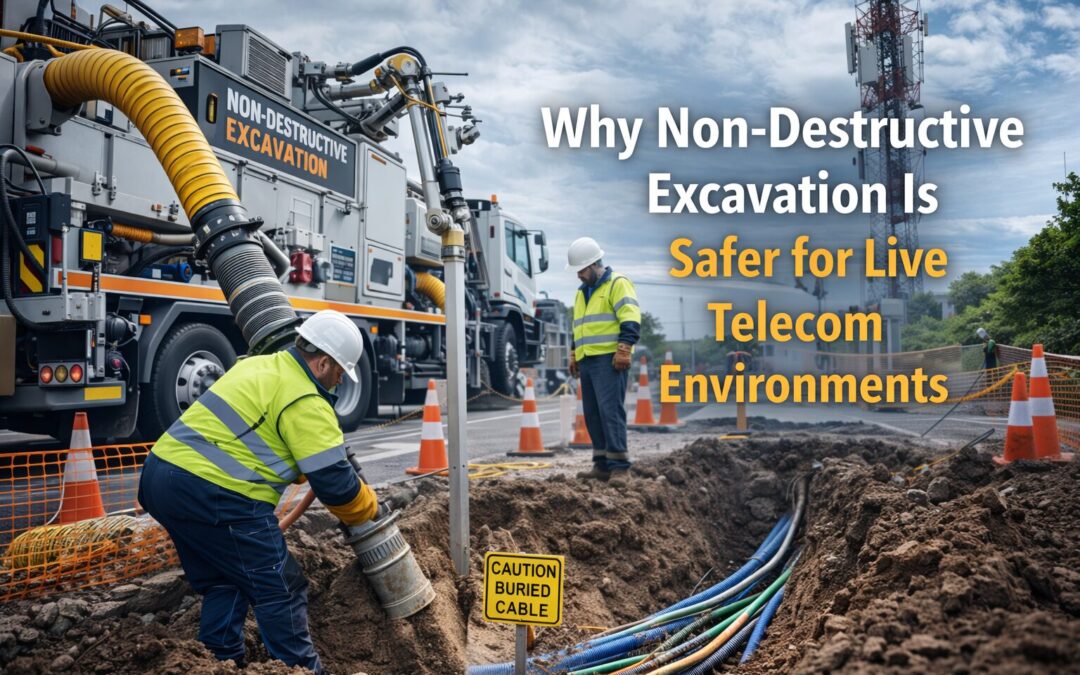
Working in live telecommunications environments leaves no margin for error. A single strike on an active fibre route or power conduit can trigger outages, safety incidents, contractual penalties, and long-term reputational damage. As networks expand and densify, excavation work is increasingly required around live assets that cannot be isolated or shut down.
This is why non-destructive excavation has become the preferred approach for civil works in active telecom environments. Rather than relying on mechanical digging that carries inherent risk, non-destructive methods allow underground services to be exposed safely, accurately, and with minimal disruption.
For network owners, principal contractors, and project managers, the choice of excavation method directly impacts safety, compliance, and delivery certainty.
The risk of traditional excavation near live telecom assets
Conventional mechanical excavation relies on force and assumption. Buckets, augers, and trenchers remove material quickly, but they do so without visibility. In live telecom corridors where fibre, copper, power, and communications infrastructure are often tightly packed and poorly documented, this creates unacceptable risk.
Striking a live asset can result in immediate service outages, emergency remediation works, and escalation from carriers or asset owners. It also exposes crews to serious safety hazards, particularly when power or pressurised services are involved. In regulated environments such as rail corridors, tunnels, and dense urban areas, the consequences extend beyond repair costs into compliance breaches and work stoppages.
As telecom projects increase in complexity, these risks compound.
What non-destructive excavation actually involves
Non-destructive excavation uses controlled air or water to loosen soil, which is then removed via a high-powered vacuum system. This process allows underground services to be exposed gradually and visually, rather than being struck blindly.
Because the method is precise and controlled, operators can identify and work around live cables and conduits without applying mechanical force. The surrounding ground remains stable, and only the required area is disturbed. This makes non-destructive excavation particularly suited to environments where live services must remain operational throughout the works.
In telecom projects, this visibility is critical. Knowing exactly where assets sit before progressing with civil works dramatically reduces risk and improves planning accuracy.
Why non-destructive excavation is safer in live environments
The primary safety benefit comes from control. Non-destructive excavation removes soil incrementally, allowing crews to stop immediately when assets are identified. This eliminates the sudden, high-impact contact that causes most utility strikes.
For workers, this means lower exposure to unexpected hazards and reduced reliance on reactive safety controls. For network owners, it means fewer incidents, fewer emergency call-outs, and greater confidence that work can proceed without disrupting live services.
Safety outcomes improve not only during excavation, but across the entire project lifecycle. When services are accurately exposed and verified early, downstream works such as trenching, pit installation, or conduit placement can be planned and executed with far greater certainty.
Compliance and regulatory expectations
Australian workplace safety and infrastructure standards increasingly favour non-destructive excavation for work near live services. Asset owners, councils, and principal contractors routinely specify vacuum or hydro excavation in high-risk areas to reduce the likelihood of asset damage.
Industry guidance from organisations such as the Common Ground Alliance reinforces the importance of accurate service location and exposure before any mechanical works take place. Following these best practices is no longer optional in many telecom environments. It is a baseline expectation.
Using non-destructive excavation demonstrates due diligence, risk awareness, and a commitment to compliance. These are critical factors in audits, tender evaluations, and long-term contractor relationships.
For further reading on best-practice underground utility protection, the Common Ground Alliance provides authoritative guidance.
Reduced outages and stronger project continuity
Live telecom environments demand continuity. Network outages, even brief ones, can affect thousands of users and trigger contractual consequences. Non-destructive excavation significantly reduces the likelihood of accidental service interruptions by allowing assets to remain untouched and operational throughout the works.
This reliability is especially important during network upgrades, DAS installations, and fibre expansions where works are staged alongside existing infrastructure. By minimising disturbance, non-destructive methods support smoother project delivery and reduce the need for contingency planning around potential strikes.
Cleaner sites and faster reinstatement
Because non-destructive excavation removes only the necessary material, it limits surface disruption and preserves surrounding ground conditions. This leads to cleaner sites, reduced spoil, and faster reinstatement once works are complete.
In public spaces, transport corridors, and operational facilities, this reduced footprint is a major advantage. It lowers the impact on surrounding assets, reduces clean-up time, and supports faster handover back to stakeholders.
How AM2PM Group delivers safe excavation in live telecom environments
At AM2PM Group, non-destructive excavation is integrated into our broader civil and telecommunications delivery model. Our teams work across live networks nationwide, supporting fibre, wireless, DAS, and civil infrastructure projects where safety and continuity are critical.
Because we self-perform civil works, excavation, and telecom delivery, we maintain full control over sequencing, safety, and quality. This allows us to plan excavation activities in direct alignment with live network constraints and project requirements.
Our experience spans complex environments including urban corridors, operational facilities, and high-risk sites where traditional excavation would introduce unacceptable risk. To learn more about how we support end-to-end delivery, explore our telecommunications services and logistics capabilities.
Choosing the right excavation method is a risk decision
In live telecom environments, excavation is not just a construction activity. It is a risk decision that affects safety, service continuity, and project outcomes. Non-destructive excavation provides the visibility, control, and assurance required to work confidently around live assets.
For network owners and principal contractors, it is the safest and most reliable way to expose underground services without compromising operations.
Frequently Asked Questions
What is non-destructive excavation in telecommunications?
Non-destructive excavation is a method of exposing underground services using air or water and vacuum systems instead of mechanical digging, allowing assets to be identified safely without damage.
Why is non-destructive excavation important in live telecom environments?
It reduces the risk of striking live fibre, power, or communications infrastructure, helping prevent outages, safety incidents, and costly remediation.
Does non-destructive excavation help with compliance?
Yes. It aligns with industry best practices and regulatory expectations for working near live services and critical infrastructure.
Can non-destructive excavation be used for pit and pipe works?
Yes. It is commonly used to expose existing services before pit installation, conduit placement, or trenching works proceed.
Is non-destructive excavation slower than mechanical digging?
While the excavation itself is more controlled, overall project timelines are often shorter due to fewer incidents, less rework, and faster approvals.
Does this method reduce environmental impact?
Yes. It disturbs less soil, preserves surrounding ground conditions, and supports cleaner site reinstatement.
Can non-destructive excavation be used in urban and restricted sites?
It is particularly well suited to dense urban environments, transport corridors, and operational facilities where space and access are limited.
Does AM2PM Group provide non-destructive excavation across Australia?
Yes. AM2PM Group delivers safe, compliant excavation and civil works nationwide as part of integrated telecom infrastructure projects.
Speak with a team that understands live networks
If your project involves excavation near live telecommunications assets, early planning makes all the difference. Contact AM2PM Group to discuss safe excavation strategies and integrated civil delivery for your next project.