
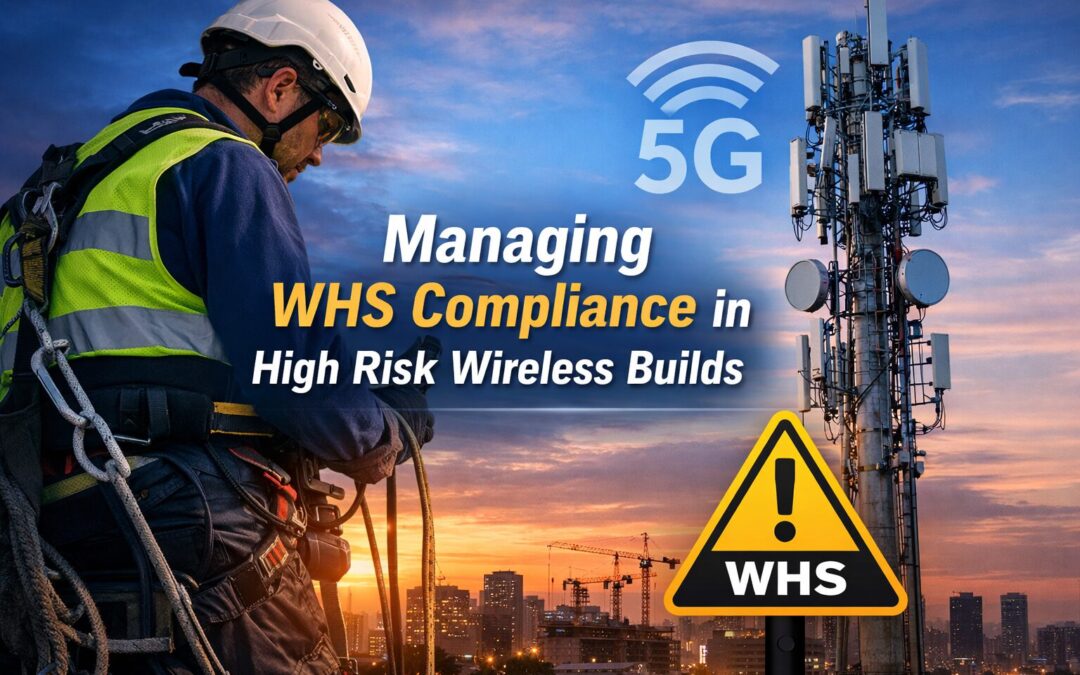
Managing workplace health and safety compliance is one of the most critical responsibilities in high risk wireless infrastructure projects. From 5G tower construction and external wireless builds to complex in-building coverage and DAS installations, WHS compliance directly impacts project timelines, workforce safety, and contractual outcomes.
In Australia’s telecommunications sector, WHS failures can result in site shutdowns, failed audits, lost carrier trust, and serious legal exposure. For contractors delivering high-risk wireless works, compliance is not an administrative task. It is a core operational capability.
At AM2PM Group, WHS compliance is embedded into every phase of project delivery, ensuring complex telecom builds are executed safely, efficiently, and in line with carrier and regulatory expectations.
Why WHS Compliance Is Critical in Wireless Infrastructure Projects
Wireless builds consistently rank among the highest risk construction environments. Crews are exposed to working at heights, live electrical systems, RF exposure, heavy plant and machinery, excavation hazards, and live operational environments such as rooftops, rail corridors, tunnels, and active commercial buildings.
Unlike standard construction, telecom projects often involve accelerated timelines, multi-disciplinary crews, and strict carrier safety frameworks. Without a robust WHS management system, even experienced teams can be exposed to unacceptable risk.
Effective WHS compliance protects workers, reduces incidents, prevents downtime, and demonstrates due diligence to clients, regulators, and principal contractors. It also enables consistent delivery across multiple sites and jurisdictions, which is essential for national wireless rollouts.
WHS Planning Before a High Risk Wireless Build Begins
Strong WHS compliance starts well before mobilisation. Pre-construction planning is where risk is identified, controlled, and documented.
Every high risk wireless build should begin with detailed site-specific risk assessments and safe work method statements that address the full scope of works. This includes access and egress, working at heights, lifting operations, electrical and RF exposure, traffic management, excavation risks, and interaction with the public or other trades.
For external builds, early planning must also consider environmental conditions, ground conditions, and logistics constraints. AM2PM Group integrates WHS planning directly into its external wireless build delivery process so safety controls are aligned with construction sequencing from day one.
Controlling Risk on Live Wireless Construction Sites
Once a project is active, WHS compliance relies on disciplined execution and consistent supervision. Controls must be practical, enforced, and adaptable to changing site conditions.
In high risk wireless environments, this includes managing fall prevention systems, isolating electrical hazards, controlling RF exposure zones, enforcing exclusion areas, and coordinating lifting and cranage activities. Civil works such as trenching, pit and pipe installation, and concrete works introduce additional hazards that must be managed under the same WHS framework.
The advantage of a vertically integrated contractor is that all crews operate under one safety system. This reduces communication breakdowns, ensures consistent standards, and improves accountability across the entire project lifecycle.
Training, Supervision, and Safety Culture
WHS compliance is only effective when it is understood and supported by the workforce. High risk wireless builds demand skilled personnel who are trained not only in their technical roles but also in site safety procedures and hazard awareness.
Regular toolbox talks, site inductions, and task-specific briefings help reinforce expectations and keep safety front of mind. Supervisors play a critical role by actively monitoring compliance, addressing unsafe behaviours early, and ensuring that safety controls remain effective as work progresses.
A strong safety culture encourages reporting of near misses and hazards without fear of reprisal. These reports provide valuable insights that help prevent incidents before they occur.
Documentation and Audit Readiness in Telecom WHS
Accurate documentation is a cornerstone of WHS compliance in telecommunications projects. Safety documentation provides evidence of due diligence and protects contractors during audits, investigations, and client reviews.
Key records include risk assessments, SWMS, training registers, plant and equipment inspections, incident reports, and site diaries. Maintaining these records in real time ensures that projects remain audit-ready and compliant with both legislative and carrier-specific requirements.
Many contractors now use digital WHS management platforms to streamline reporting, inspections, and compliance tracking. These systems improve visibility across multiple sites and support continuous improvement across large-scale wireless programs.
Staying Compliant With Australian WHS Regulations
Telecommunications contractors must comply with Safe Work Australia legislation as well as state-based WHS requirements. In addition, major carriers and infrastructure partners impose their own safety standards, reporting protocols, and audit frameworks.
Because wireless infrastructure projects often span multiple states and asset types, staying current with regulatory changes is essential. A proactive approach to compliance ensures that safety systems evolve alongside regulatory and industry expectations.
WHS Compliance as a Competitive Advantage
In high risk wireless construction, WHS compliance is more than risk mitigation. It is a differentiator.
Clients and principal contractors actively seek partners who can demonstrate safe, repeatable delivery in complex environments. A proven WHS framework reduces project risk, supports faster mobilisation, and builds long-term trust with Tier 1 clients.
AM2PM Group’s in-house delivery model ensures full control over safety, quality, and compliance across every stage of wireless and civil infrastructure works.
Frequently Asked Questions
What makes wireless infrastructure projects high risk?
Wireless builds involve working at heights, live electrical systems, RF exposure, heavy machinery, and often active public environments, all of which increase risk.
Who is responsible for WHS compliance on a wireless build?
The principal contractor holds overall responsibility, supported by supervisors and workers who must follow approved safety systems and procedures.
How early should WHS planning begin on a telecom project?
WHS planning should begin during project scoping and site assessment, well before mobilisation.
What documentation is required for WHS compliance?
Typical documentation includes risk assessments, SWMS, training records, equipment inspections, and incident reports.
How is WHS managed on multi-site wireless rollouts?
Centralised WHS systems and consistent procedures across all crews ensure uniform compliance across multiple sites.
Are digital WHS tools useful for telecom projects?
Yes. Digital platforms improve reporting, audit readiness, and visibility across complex programs.
What happens if WHS compliance is not met?
Non-compliance can result in site shutdowns, fines, contract termination, and reputational damage.
Does WHS compliance slow down projects?
When managed correctly, strong WHS systems reduce delays by preventing incidents and rework.
How does AM2PM Group manage WHS across its projects?
WHS is embedded into planning, delivery, supervision, and documentation across all in-house teams.
Talk to a High Risk Wireless Build Specialist
If you are planning a high risk wireless infrastructure project and need a contractor with proven WHS systems, experienced crews, and full in-house control, speak with the team at AM2PM Group.