
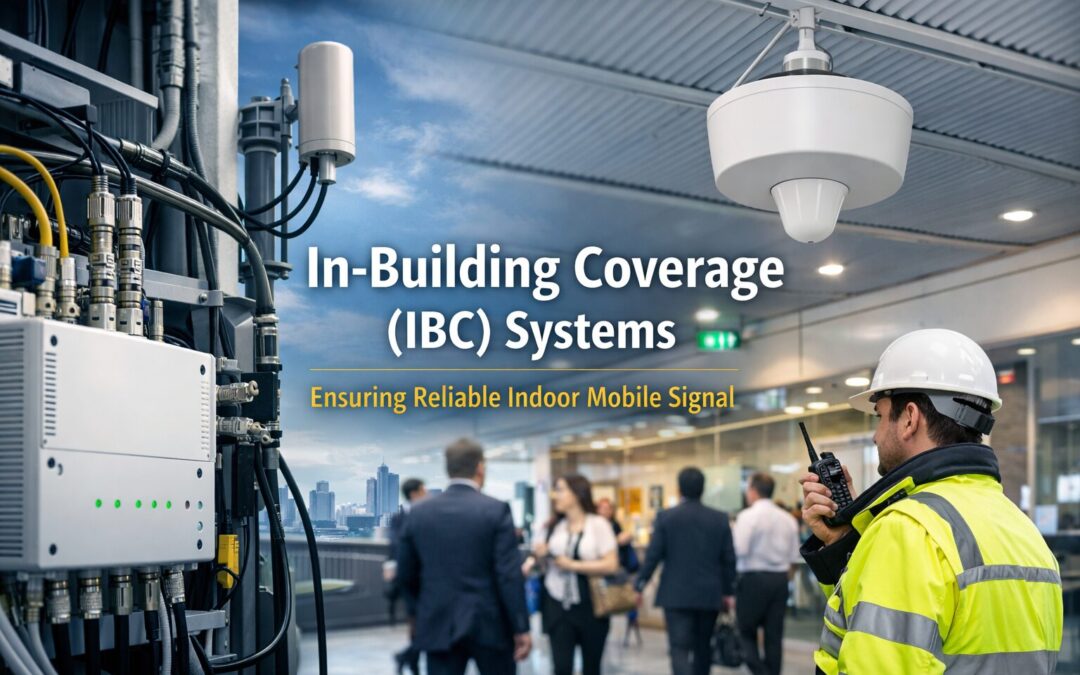
Reliable mobile coverage inside buildings is no longer optional. In commercial, industrial, and infrastructure environments, poor indoor signal impacts safety, productivity, and operational continuity. This is where an In-Building Coverage system, commonly referred to as an IBC system, becomes essential.
An In-Building Coverage system is a purpose-designed telecommunications solution that delivers consistent mobile voice and data coverage throughout a structure where outdoor cellular signals cannot reliably reach. These systems are widely used across commercial buildings, transport infrastructure, tunnels, hospitals, stadiums, and large industrial facilities.
As buildings become larger, denser, and more complex, traditional outdoor mobile networks alone are no longer sufficient. An IBC system ensures that occupants, staff, and critical services maintain reliable connectivity everywhere inside the asset.
What Is an In-Building Coverage System?
An In-Building Coverage system is a network of telecommunications equipment designed to capture a strong external mobile signal and distribute it throughout the interior of a building.
Most modern buildings are constructed with materials such as reinforced concrete, steel, and low-emissivity glass. These materials significantly weaken mobile signals before they reach indoor spaces. Basements, plant rooms, lift cores, and underground areas are particularly affected.
An IBC system overcomes this by using rooftop antennas, donor antennas, or carrier connections to bring signal into the building. That signal is then conditioned, amplified, and distributed through a network of internal antennas to provide consistent coverage across all required areas.
IBC systems are often delivered using a Distributed Antenna System, or DAS, as the internal distribution layer. You can learn more about this approach on AM2PM Group’s dedicated IBC and DAS services page.
How an IBC System Works in Practice
An IBC system is not a single piece of equipment. It is an engineered solution that must be designed specifically for the building, its layout, and its expected usage.
The process typically begins with a radio frequency survey to assess existing signal levels and identify coverage gaps. From there, engineers design a system that balances signal strength, capacity, and future scalability.
The system may be passive, active, or hybrid. Passive systems are generally used in smaller or less complex buildings and rely on coaxial cabling without powered amplification. Active and hybrid systems are used in large or high-traffic environments and provide greater control, capacity, and performance using powered equipment and structured cabling.
In complex environments, IBC delivery often requires close coordination with civil, electrical, and construction works. Contractors that self-perform these scopes can significantly reduce risk, delays, and rework. This is particularly important in live sites, tunnels, and transport infrastructure where access and safety requirements are strict.
When Do You Need an In-Building Coverage System?
Many asset owners only consider IBC after complaints begin. By that stage, the problem is already impacting operations.
There are several clear indicators that an IBC system is required.
If mobile calls frequently drop inside the building, data speeds are inconsistent, or coverage varies dramatically between floors or rooms, the building is likely relying on weak outdoor signal penetration.
Facilities with high occupant density, such as hospitals, shopping centres, stadiums, and office towers, often experience congestion even when signal appears present. An IBC system addresses both coverage and capacity.
Underground or enclosed environments such as basements, tunnels, rail corridors, and plant rooms almost always require dedicated in-building coverage. Outdoor networks are not designed to serve these spaces reliably.
IBC systems are also increasingly driven by compliance and safety requirements. Many projects require reliable indoor coverage to support emergency services, operational communications, and public safety systems. In some cases, in-building coverage is mandated as part of planning approval or handover requirements.
Retrofitting an IBC system after construction is complete is significantly more expensive and disruptive than integrating it early. For this reason, IBC should be considered during design and construction, not as an afterthought.
IBC Systems in High-Risk and Complex Environments
Not all IBC projects are equal. Installing coverage in a standard office building is very different from delivering coverage in a tunnel, rail environment, or live infrastructure site.
High-risk environments require contractors who understand work sequencing, WHS compliance, and coordination across multiple trades. Poorly planned IBC installations can delay projects, fail carrier acceptance, or introduce safety risks.
AM2PM Group specialises in delivering IBC systems in complex environments by self-performing excavation, civil works, electrical, installation, and commissioning. This integrated delivery model reduces interface risk and ensures accountability from design through to handover.
Planning IBC Early Saves Time and Cost
One of the most common mistakes in building projects is leaving in-building coverage until late in the program. By that point, ceiling spaces are congested, access is limited, and installation becomes slower and more expensive.
Early IBC planning allows system design to align with architectural, electrical, and civil works. It also enables coordination with mobile carriers and authorities before deadlines are missed.
For large or multi-site projects, early engagement with an experienced contractor can prevent costly redesigns and ensure consistent coverage outcomes across assets.
Frequently Asked Questions About In-Building Coverage Systems
What does IBC stand for in telecommunications?
IBC stands for In-Building Coverage. It refers to systems designed to deliver reliable mobile signal inside buildings where outdoor coverage is insufficient.
Is an IBC system the same as a DAS?
A Distributed Antenna System is commonly used as part of an IBC solution. The IBC system includes signal capture, conditioning, and distribution, while DAS refers specifically to the internal antenna network.
Do IBC systems support 4G and 5G networks?
Yes. Modern IBC systems are designed to support current 4G services and are scalable to support 5G and future technologies.
Who is responsible for providing IBC in a building project?
Responsibility typically sits with the building owner or developer, particularly where coverage is required for safety, compliance, or tenant requirements.
Are IBC systems mandatory in Australia?
Requirements vary by project type and jurisdiction. Some infrastructure and public facilities require in-building coverage to support emergency and operational communications. Guidance is provided by authorities such as the NSW Telco Authority.
Can an IBC system support multiple mobile carriers?
Yes. Properly designed systems can support multiple carriers, subject to approvals and design constraints.
What happens if an IBC system is installed incorrectly?
Poor design or installation can result in dead zones, interference, failed carrier acceptance, and costly rework. This is why experienced, accredited contractors are critical.
How long does an IBC installation take?
Timeframes vary depending on building size and complexity. Early planning significantly reduces installation time and disruption.
Can IBC systems be added to existing buildings?
Yes, but retrofits are typically more complex and expensive than integrating IBC during construction.
Talk to an IBC Contractor Who Delivers End to End
In-Building Coverage is no longer a nice-to-have. It is critical infrastructure that supports safety, performance, and long-term asset value.
If you are planning a commercial build, managing an infrastructure upgrade, or experiencing indoor coverage issues, engaging an experienced IBC contractor early can save time, cost, and risk.
AM2PM Group delivers IBC and DAS systems nationwide with fully in-house teams covering civil works, electrical, installation, and commissioning.
To discuss your project or arrange a site assessment, contact AM2PM Group.